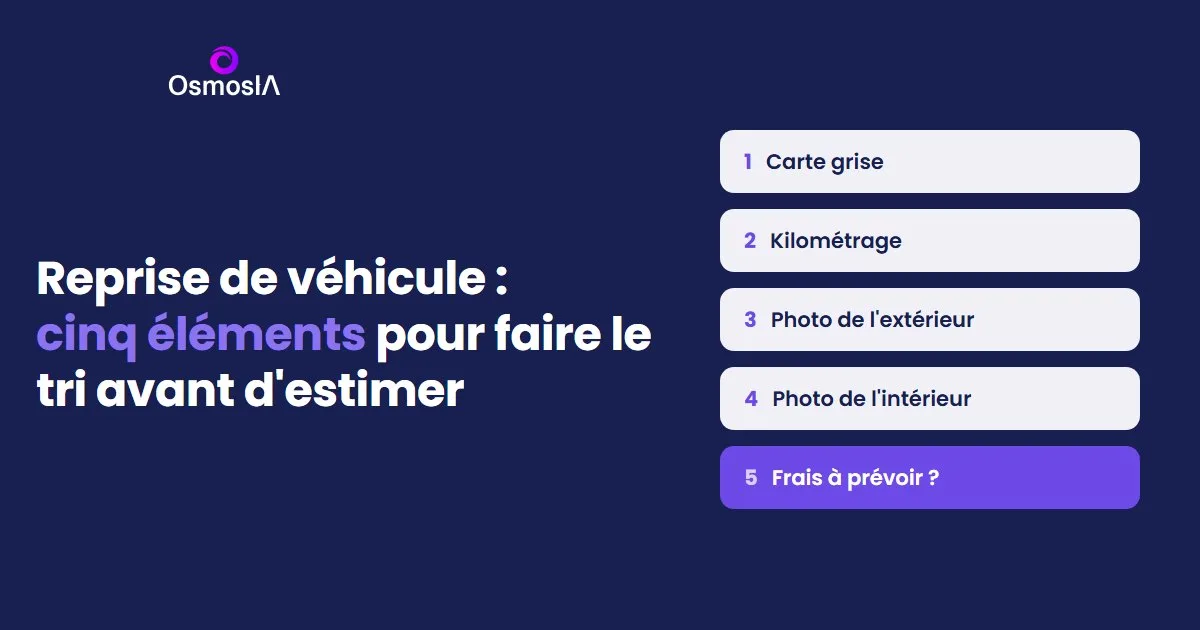
Vehicle trade-ins: five items to sort them out before you estimate

“Will you take my car in part-exchange?” The message arrives with no plate, no mileage, no photo. The seller then has two bad options: throw out a figure at random, or send a list of documents so long that the owner never replies. In between, there is a first message that asks for just what is needed to know whether the trade-in is worth stopping for.
Two steps people confuse: sorting and the firm offer
A trade-in happens in two stages, which do not need the same information.
- Sorting, remotely. It tells the seller whether the trade-in is serious, and the owner whether it is worth discussing. It leads to a first price range, indicative, which does not commit the dealer.
- The firm offer, after inspection. It is made on seeing the vehicle, in the presence of its owner. A final offer should not be made remotely, and the dealer is under no obligation to make one anyway.
Asking for too little in the first message means estimating for nothing. Asking for the documents of the firm offer means losing the owner.
The five items in the first message
- A copy of the registration certificate. In one go it gives the registration number, make, model, fuel type and date of first registration. No need to ask five questions to identify the car.
- The mileage. It does not appear on the registration certificate, and it weighs heavily in the valuation. Always ask for it.
- A photo of the exterior. Just one, from the front three-quarter angle, is enough to see the car’s overall condition.
- A photo of the interior. Just one, from the driver’s side: seats, steering wheel, dashboard.
- Costs to expect, as an open question. “Are there any costs to expect on the car?” The owner says what they know, in their own words: tyres to replace, a timing belt due, a warning light on.
Two photos, not twenty. One open question, not a questionnaire.
Why these five: sorting
This first message does two things.
- Knowing whether the trade-in is serious. Sending your registration certificate and two photos is already a commitment. An owner who does it has a real plan, and the seller knows where to spend their time.
- Avoiding estimating for nothing. A car the dealer will not take, or whose stated costs eat up its value, shows up in the very first exchange. No need for an appointment to find out.
The registration certificate: personal data, to be treated as such
A copy of the registration certificate carries the holder’s name and address. It is requested because it identifies the car precisely, and it is kept only for as long as it takes to handle the trade-in. An owner who would rather not send it can give the registration number instead: you do not block a trade-in over a document.
The message, in practice
“With pleasure. Could you send me a copy of the registration certificate, the mileage, a photo of the exterior and one of the interior? And are there any costs to expect on the car? That will let me give you an estimate, which will be refined at an appointment after inspecting the vehicle.”
Four short requests and one open question. The owner knows what they are giving, and what will happen next.
At Osmosia: the minimum, and the maximum on request
These five items are the minimum we recommend to our dealers: enough to sort, not so much that it discourages. A dealer who wants to go further from the first exchange (detailed photos, invoices, roadworthiness test) sets it up for their agency.
Three steps, starting this week
- Reread your trade-in message. Count the requests. Keep what helps you sort, and leave the rest for the appointment.
- Replace the twenty photos with two. One of the exterior, one of the interior.
- Add a sentence about what comes next. “That will let me give you an estimate, which will be refined at an appointment after inspecting the vehicle.” It protects the seller and sets the right expectation.
The rule applies well beyond trade-ins: ask for what you need to decide on the next step, and nothing more.
FAQ
What you're probably wondering
In practice, no. A remote estimate remains indicative: the firm offer is made after a physical inspection of the vehicle, in the presence of its owner.
Because it identifies the car precisely in a single document: registration number, make, model, fuel type, date of first registration. It also carries personal data: an owner who would rather not send it can give the registration number instead.
No. They have no obligation to make an offer, and an estimate given remotely does not commit them.
Read next
-
 Qualification
"Is that your best price?": answering without cutting your margin
A discount request is not a buying signal. How to sort hagglers from real buyers, frame the reply, and move the talk off the inbox.
Pierre Osmont July 9, 2026 7 min -
 Qualification AI & Automation
Missed appointments: what actually reduces no-shows
Cutting missed appointments: what SMS reminders prove (meta-analysis, RR 0.77), what qualification is worth, and where French privacy law draws the line.
Pierre Osmont June 16, 2026 6 min -
 Qualification
Qualifying and scoring an automotive lead: the method that actually sorts
Automotive lead scoring: the signals that actually count, the thresholds that trigger a call, and why a stated budget proves almost nothing.
Pierre Osmont May 28, 2026 7 min

And you, what's your news?
Let's talk it through, Test Osmosia on your listings.
- A reply to every message in under 15 minutes, 7 days a weekReplies 7 days a week in under 15 minutes
- Prospects qualified and scored automatically
- Appointments booked in your calendar