
Car agency franchises: unifying lead replies across the whole network

One national brand, dozens of independent business owners, and a buyer who messages three branches on a Sunday evening. What that buyer remembers is not the signage or the brand colours. It is how fast the reply came, how it was written, and whether it was spelled correctly.
France has around fifteen networks of what the trade calls car agencies, franchised businesses that broker used vehicle sales between private sellers and buyers, on the model of estate agents. Unifying how they reply to leads comes down to three decisions: a response window every branch commits to, a shared way of writing, and one rule about when the network’s services are introduced. Everything else, the vehicle and the local relationship, belongs to the franchisee.
The evidence on speed is old and sturdy. Harvard Business Review measured in 2011, across an audit of 2,241 US companies, an average response time of 42 hours to online leads and 23 % of companies that never replied at all; those replying within the hour were roughly seven times more likely to have a qualifying conversation. That is not a question of individual effort. It is a question of organisation, and in a network it is measured branch by branch.
In a network, the gap between two branches is a gap in the brand
A buyer does not separate the branch from the network. They saw a brand on a listing, they wrote, they waited. Ten minutes at one address and two days of silence at another does not read as one badly run branch. It reads as a brand that does not answer.
This is the specific problem of franchising applied to vehicle transactions. The contract transfers know-how, a sales method, a visual identity, often a listing distribution tool. The conversation almost never makes it into that transfer. Every franchisee writes the way they write, replies when they can, and improvises the way they present the network’s services.
The gap opens exactly where the value sits. The Lead Response Management Study run by MIT and InsideSales in 2007, covering more than 15,000 leads and more than 100,000 calls, established that reaching out within five minutes rather than thirty multiplies the odds of making contact by roughly one hundred and the odds of qualifying the lead by roughly twenty one. Those multipliers describe access to the conversation, not an extra sale. In a network, that access depends on who picks up, and at what hour.
With no stock, the franchisee’s only raw material is inbound contacts
The car agency model exists because of a very concrete obstacle. Guillaume Herbin, co-founder of BH Car, told Franchise Magazine in February 2026 that his franchisees are car enthusiasts who could not make a living from that passion, since the cost of entry into buying and reselling vehicles often runs into hundreds of thousands of euros. The agency format is the answer to that wall: you do not finance a lot full of cars, you finance a brand, premises and a method.
The operational consequence follows. An independent used car trader optimises the rotation of stock they have paid for. A franchisee has tied up nothing in vehicles. Their output depends entirely on how many inbound contacts they turn into sale mandates and completed deals. Leads are not one channel among several. They are the raw material.
One qualification matters here, because the model is not uniform across brands. Yoni Dayan, founder of SimpliciCar, argued in L’Argus in March 2025 that these professionals should be recognised as intermediaries, stressing that they are not traders since the vehicles do not belong to them. The same brand’s legal terms in 2026 describe a different mechanism, in which the agency buys and then resells once the final buyer is identified, acting as a professional seller. Some brands operate pure brokerage, others buy and resell at the moment of the transaction. That distinction drives the applicable warranty and liability, and it belongs with qualified legal counsel rather than in a blog article.
The market backdrop is steadier. Private to private transactions accounted for 47 % of the French used vehicle market in 2025 according to NGC-Data, excluding overseas territories. The private seller who handles it alone remains the networks’ first competitor, an analysis Franchise Magazine also set out in February 2026, drawing on a Xerfi study from June 2024. Convincing that seller to hand over their car starts with being reachable.
38 to 45 cars a month, the scale that breaks manual handling
Michaël Ledoux, head of TransakAuto, told L’Argus in March 2025 that a well performing branch should sell between 38 and 45 cars a month, and that slightly under 10 % of his network was in the red at the time. Both figures come from a franchisor rather than an independent audit, and their value lies in what they say about scale.
Forty sales a month in a two or three person business means a volume of inbound conversations that nobody handles properly between two test drives and a registration errand. Every listing on leboncoin or La Centrale brings its own messages, follow-ups and requests for photos or inspection reports. Triage then happens by whatever sits at the top of the inbox, not by what carries the most value.
The share of struggling branches, acknowledged publicly by the network’s own leadership, says the rest. In this business, the difference between a branch that holds and one that slips is rarely face to face selling skill. It is what happens before the meeting ever takes place.
What the franchisor promises, what the franchisee carries
Network recruitment pitches are explicit: the franchisor sells contact volume. AutoEasy claims on its franchise page, consulted in July 2026, more than 100,000 monthly visitors and more than 5,000 qualified seller leads generated each month for its franchisees, along with listing distribution at negotiated rates. These are self-reported brand figures, unverifiable by a third party, and they describe the commercial promise of the model accurately.
Conversion is never promised. It happens in the branch, message by message. An entry fee and a monthly royalty are amortised on completed transactions, not on visits. An unhandled lead therefore costs twice: the lost margin, and the share of the royalty it should have funded.
That is why lead handling is a legitimate concern at network level. It is not about franchisee comfort. It determines the economic health of the network, and therefore its capacity to keep opening branches.
Standardise without turning replies into scripts
The instinct at head office is to write template replies and circulate them. Templates end up in a shared folder, used by the people who needed them least. The right unit of standardisation is not the message. It is the conversation rule.
What a network should unify
The response window first: a committed, identical figure everywhere, evenings and weekends included, because that is when buyers write.
Then the way replies are written: message length, register, spelling, posture. An adviser who answers the question that was asked, without reciting a pitch and without pushing for an appointment. Nothing that reads like a script.
Finally the qualification rule: which signals mark a contact as serious and worth escalating to the franchisee. A confirmed appointment, a proposed time slot, a request for a phone call, a document sent all weigh heavily. A stated budget, a financing intention, a colour preference weigh little. Written once, that hierarchy holds across the network.
What stays with the branch
The vehicle and its listing, which the franchisee knows and nobody at head office ever will. The diary, the opening hours, the lunch break. Willingness to negotiate, decided car by car depending on margin and how long the file has been open. The phone number shown, whether the franchisee’s or the branch’s.
Osmosia is configured at that level: each branch has its own interface, qualification threshold, opening hours, follow-up delays and notifications. Network consistency does not come from a central console. It comes from a shared way of writing and a shared qualification rule, deployed branch by branch. A network looking for something other than conversational consistency is looking for a different product.
Introducing the network’s services at the right moment
Trade-ins, financing, warranty, delivery, vehicle preparation: these services are what a network offers over a private seller working alone. They are also what franchisees forget to mention, or mention all at once in a first reply that reads like a brochure.
The rule that works is the opposite of exhaustiveness. Answer the main point the buyer raised. Add a further piece of information only when it carries immediate value for the question asked. A buyer three hundred kilometres from the branch is the only one for whom the existence of a delivery service means anything, and even then it should be mentioned plainly, without a commercial push.
Standardising how services are presented is therefore not about a paragraph to paste everywhere. It is about writing down, service by service, the moment in a conversation when it becomes relevant. That is head office work, done once, and it deploys without asking anyone to adopt anything.
Time given back to the franchisee goes into winning mandates
A car agency franchisee does not produce output by answering messages. They produce it by signing sale mandates, valuing vehicles at people’s homes and taking buyers out on test drives. Hours spent sorting an inbox are hours taken from the only activity that refills the listing pipeline.
The trade-off matches the one estate agents face: the scarce resource is not the contact, it is the selling time available to convert it. Automating the first reply and the qualification step does not replace the franchisee. It gives back the hours during which they sell.
The reasoning stops there, deliberately. No figure for time saved or conversion gained will be put forward until it rests on verified client data. A network considering a rollout should measure it themselves, branch by branch, on their own leads.
Limits to set before rolling out
Three precautions, in the order they arise.
Compliance first. Automated handling of prospect messages and intent scoring require informing the individuals concerned and documenting the framework around it. France’s data protection authority, the CNIL, publishes dedicated recommendations on deploying artificial intelligence systems that process personal data. How responsibility for those processing activities is shared between franchisor and franchisee is a contractual question, settled with qualified legal counsel rather than in a guide.
Product scope second. Osmosia replies in under fifteen minutes, seven days a week from 7am to 11pm, qualifies contacts through scoring and books appointments. What is measured is response time, intent score and appointments booked. Not the full chain through to the sale, which depends on the franchisee, the vehicle and the price.
Franchisee buy-in last. A franchisee is an independent business owner, not an employee of the network. A conversation tool imposed without leaving them local control over tone, hours and willingness to negotiate will be worked around within a month. Standardisation that holds is the kind that leaves each owner in charge of what belongs to their own business.
FAQ
What you're probably wondering
Yes, provided the network standardises conversation rules rather than message templates. Three things are worth unifying across a network: the response window, the shared way of writing and the qualification rule for inbound contacts. The vehicle, the diary, willingness to negotiate and the contact details shown stay with the franchisee, who remains an independent business owner.
As short as possible, ideally under an hour. Harvard Business Review measured an average response time of 42 hours to online leads in 2011, with 23 % of companies never replying, and roughly a seven to one advantage in qualifying conversations for those replying within the hour. MIT and InsideSales had established in 2007 that reaching out within five minutes rather than thirty multiplies the odds of making contact by around one hundred.
Michaël Ledoux, head of TransakAuto, told L'Argus in March 2025 that a well performing branch sells between 38 and 45 cars a month, and that slightly under 10 % of his network was in the red at that point. These are franchisor figures, not independently audited. They indicate how demanding the model is rather than setting a market benchmark.
It depends on the brand, and sometimes on the individual deal. Some networks work on pure brokerage, with the vehicle remaining the private seller's property, while others buy and resell at the moment of the transaction, acting as a professional seller. Warranty and liability differ accordingly, which makes this a question for qualified legal counsel.
By tracking the same indicators everywhere: time to first reply, share of contacts left unanswered, share of contacts qualified and number of appointments booked. Those indicators only compare across branches if they are calculated the same way in each one. Osmosia measures response time, intent score and appointments booked, not the full chain through to the sale.
Osmosia replies to messages received on listings in under fifteen minutes, seven days a week from 7am to 11pm, qualifies contacts through scoring and books appointments. Each branch keeps its own interface, qualification threshold, opening hours, follow-up delays and notifications. Network consistency comes from the shared way of writing and the shared qualification rule, deployed branch by branch.
Read next
-
 Sales Strategy
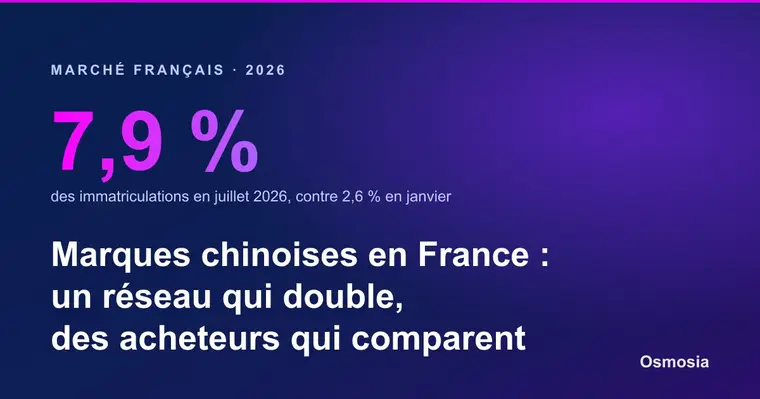
Chinese brands in France: a network doubling, buyers comparing
7.9 % of the market in July 2026, against 2.6 % in January. Networks are built in months, and buyers arrive with questions nobody had to handle before.
Pierre Osmont September 27, 2026 6 min -
 Sales Strategy
leboncoin messages: the method distilled from 10,000 seller conversations
Built with over 100 car sellers and more than 10,000 messages received: the four requests that always come back, and how to answer them without losing your mornings.
Thomas Forget August 31, 2026 8 min -
 Sales Strategy
Buying a used car: dealer or private seller?
France's used car market splits almost evenly between the two. What actually differs between a professional seller and a private one.
Pierre Osmont July 9, 2026 6 min

And you, what's your news?
Let's talk it through, Test Osmosia on your listings.
- A reply to every message in under 15 minutes, 7 days a weekReplies 7 days a week in under 15 minutes
- Prospects qualified and scored automatically
- Appointments booked in your calendar