
Following up on car leads without sounding pushy: it comes down to timing

A buyer who stops replying is rarely a lost buyer. He is busy, he is comparing, he is waiting on a finance decision, he asked the same question to four sellers. The silence is almost never the problem. Yours is.
Harvard Business Review (2011), auditing 2,241 US companies, measured an average response time of 42 hours and found that 23 % of firms never replied at all. The figure is fifteen years old, and it still describes a used car lot on a Saturday evening with precision: messages come in, nobody handles them, and by Monday they are cold.
Follow-up corrects that gap. Provided it does not turn into pressure, which is exactly what most professional sellers fear so much that they never follow up at all.
Silence is not a refusal, it is a missing signal
Inside a classifieds inbox, a buyer almost never says no. He simply stops replying. The seller reads that void as a polite refusal, moves to the next lead, and lets a file die that only needed one question.
Velocify, in “The Ultimate Contact Strategy” (around 2013, based on roughly 3.5 million leads), claimed that about 93 % of converted leads are reached on the sixth call. That figure comes from a sales software vendor with a direct interest in proving the value of follow-up: it points to a direction, not to a market truth. The direction is unambiguous. The first contact does not close.
That said, six messages in three days does not create six chances. It creates a reputation.
The cadence that works: 24 hours, 72 hours, 7 days
Three follow-ups, spaced out, each with its own purpose. The clock does not start when you send your message, it starts with the buyer’s last reply. Most sellers miss that distinction: you follow up on a silence, not on a calendar.
First follow-up, probe while interest is warm
Twenty-four hours after the buyer’s last reply. One short, direct question anchored in something specific from the exchange: the model, a feature he mentioned, a concern he let slip. One sentence is enough. “Still interested in this car?” works better than a sales paragraph, because it takes three seconds to process.
Second follow-up, widen the conversation to the search
Seventy-two hours after the buyer’s last reply, and only if the first follow-up produced nothing. The subject is no longer the vehicle, it is the search. “How is your search going?” opens a door that “are you still interested?” closes. A buyer who bought elsewhere will tell you. One who is still hesitating will tell you what about.
Third follow-up, close the file cleanly
Seven days. Two follow-ups already sent, no reply. This message is not a sales attempt, it is a dignified exit. “Has your project changed?” releases the buyer and releases you. A file closed cleanly can reopen. A file closed through fatigue never does.
What separates a useful follow-up from an empty one
A useful follow-up carries something the previous message did not: a new availability, an answer to an unspoken question, information on the vehicle, a wider view of the search. An empty follow-up repeats the unanswered question, louder.
Price negotiation makes the point. A buyer who asked for 1,500 euros off and then went quiet is not waiting to be asked whether he is still interested. He is waiting to know whether his budget moved, or whether yours did. Following up on price, when price is the sticking point, reactivates the sticking point. Following up on the state of his thinking keeps the door open without conceding a euro.
Second rule: length betrays intent. A short message reads like a question between professionals. A long one reads like a sales pitch, and gets treated as one.
Knowing when to stop, the rarest skill
Some signals are explicit. “Too expensive.” “I found something else.” “I am no longer looking.” These are not objections to handle, they are ends of conversation. Pushing past them turns a neutral buyer into a detractor, on platforms where sellers number in the thousands and reputation travels.
Other signals are implicit and harder to read: two follow-ups with no reply, a conversation that regresses, a buyer who answers out of politeness without ever offering a date. The seller handling leads by hand reads them badly, because he reads them late, between a test drive and a supplier call.
Osmosia relies on intent scoring to make the call. A request for a phone call, a proposed date, a confirmed appointment push the score up. A declared abandonment pushes it down, and the follow-up sequence stops. The seller no longer decides whether to follow up. He decides who to call back.
What an unfollowed lead really costs
The cost of a missed follow-up is not measured in lost sales, a phrase too vague to commit anyone. It is measured in days of inventory.
According to the Mobilians and Avere-France barometer (Q4 2025), the average resale time for a used electric vehicle stood at 161 days across all ages, against a professional stock of 61,613 units. One hundred and sixty-one days of tied-up capital, insurance, depreciation. Every day gained on a buyer conversation has a price, and that price is yours.
The context sharpens the equation. Used vehicles under five years old declined by 7 % in 2025 (AAA Data). The recent used car has become a scarce resource: a lead on that segment is not replaced by another lead.
Automate the cadence, keep the judgement
What makes manual follow-up bad is not the seller. It is that it depends on him, on a Tuesday at 7.30 pm, after eleven hours on the lot.
Osmosia answers classifieds messages in under 15 minutes, seven days a week, from 7am to 11pm, then runs follow-ups on a configurable cadence, set by default at 24 hours, 72 hours and 7 days after the buyer’s last reply. Each message picks up a concrete element of the conversation, stays short, and respects the company’s tone. The sequence stops on any signal of abandonment.
Salesforce, in its State of Sales 2026 report (4,050 sales professionals surveyed, France included), documents a telling case: its agents re-engaged 130,000 previously neglected leads and generated 3,200 opportunities in four months. Salesforce measures its own customers, so read the figure as a direction. That direction says something simple: the opportunity is not in the leads you do not have yet, it is in the ones you already let go quiet.
Following up is not insisting. It is refusing to let a file die of silence, and knowing how to bury it once it is dead.
FAQ
What you're probably wondering
In most cases, yes. Silence in a classifieds inbox rarely means refusal: the buyer is comparing, waiting on financing, or has written to several sellers. Velocify, a sales software vendor, claimed around 2013 that 93 % of converted leads are reached on the sixth call. Read that vendor figure as a direction: the first contact rarely closes.
A cadence of 24 hours, 72 hours and 7 days after the buyer's last reply covers almost every case. The clock starts with the buyer's silence, not with the message you sent. Osmosia applies that cadence by default, and the seller can configure it.
A follow-up brings something new: an availability, information on the vehicle, a wider view of the buyer's search. Harassment repeats the same question, louder. Content matters more than frequency: three spaced, useful messages land better than one empty message sent twice.
As soon as an explicit signal appears: "too expensive", "I found something else", "I am no longer looking". These sentences end the conversation and are not objections to handle. Two follow-ups with no reply is an implicit signal strong enough to close the file cleanly.
No. Following up on price reactivates the sticking point. Ask instead where his thinking or his budget stands, without mentioning the discount or the amount. The door stays open and no concession is made.
It does when it is generic. A follow-up that picks up a specific element of the conversation, fits in one sentence and respects the company's tone reads like a message from a seller. Osmosia writes each follow-up from the conversation history, without templates.
Read next
-
 Sales Strategy
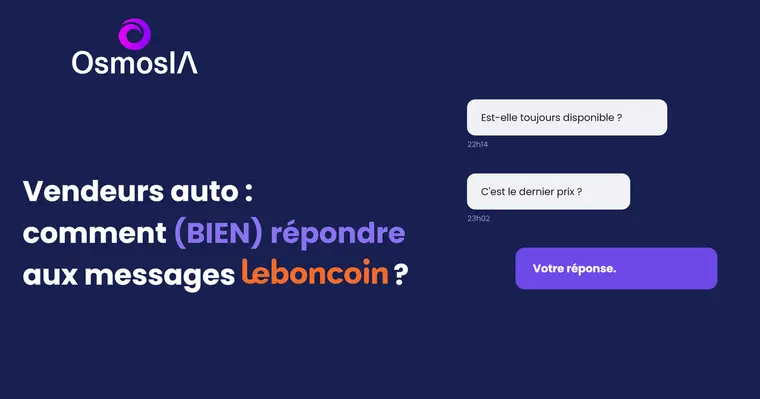
leboncoin messages: the method distilled from 10,000 seller conversations
Built with over 100 car sellers and more than 10,000 messages received: the four requests that always come back, and how to answer them without losing your mornings.
Thomas Forget August 31, 2026 8 min -
 Sales Strategy
Car agency franchises: unifying lead replies across the whole network
In a car agency franchise, the reply a buyer gets is a brand asset. What a network should standardise, and what belongs to the branch.
Pierre Osmont July 24, 2026 8 min -
 Sales Strategy
Buying a used car: dealer or private seller?
France's used car market splits almost evenly between the two. What actually differs between a professional seller and a private one.
Pierre Osmont July 9, 2026 6 min

And you, what's your news?
Let's talk it through, Test Osmosia on your listings.
- A reply to every message in under 15 minutes, 7 days a weekReplies 7 days a week in under 15 minutes
- Prospects qualified and scored automatically
- Appointments booked in your calendar