Chinese brands in France: a network doubling, buyers comparing

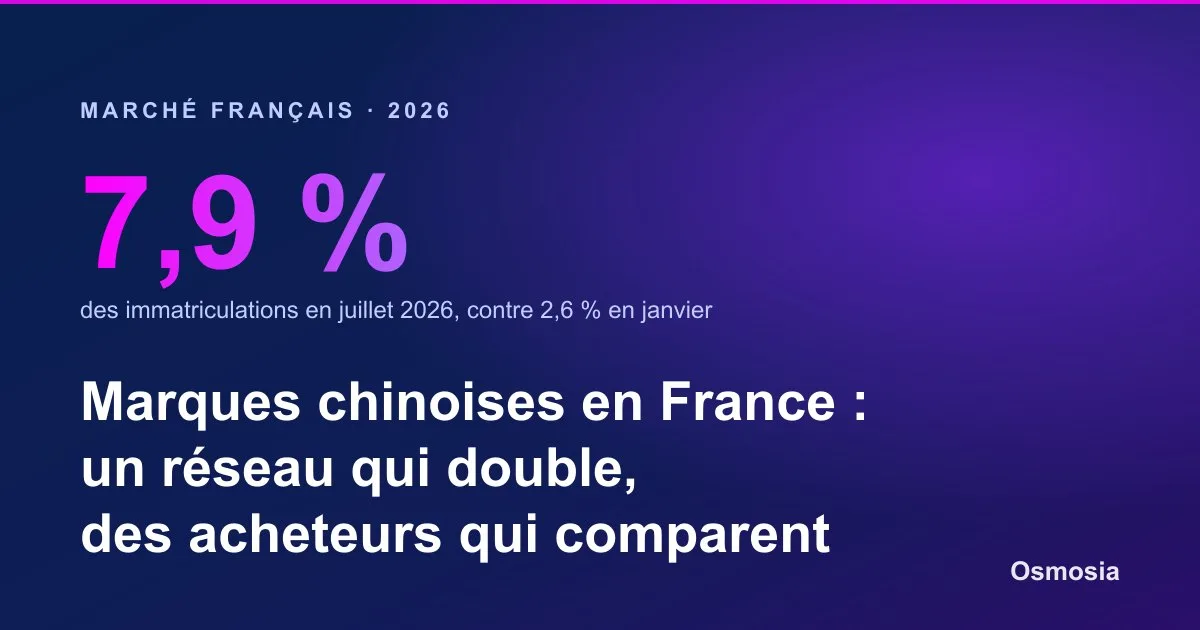
Between January and July 2026, the share of Chinese brands in French registrations rose from 2.6 % to 7.9 %. In July that meant 10,076 passenger cars out of a 126,808-unit market, according to the monthly count published by Le Journal de l’Automobile. For a dealer network, that figure is not a market curiosity: it is a stream of inbound enquiries that did not exist eighteen months earlier.
The ranking changes from month to month
Over the first half of the year, the fourteen Chinese brands sold in France registered 41,048 cars, or 4.8 % of the market, according to Automobile Propre. MG led with 16,417 units, ahead of BYD at 13,546, up 140.2 %.
Then the order changed. In August, BYD registered 2,145 cars and moved ahead of MG, at 2,003. Omoda and Jaecoo, the two Chery group brands that had arrived four months earlier, already placed 1,608 vehicles in that single month. The passenger car market stood at 94,351 units, 38.3 % of them electric.
A salesperson comparing these figures with their own order book sees one thing above all: buyers who used to hesitate between two established brands now compare three or four offers, at least one of which they had never heard of last year.
The network is built faster than the working habits
These brands are not opening a few showrooms. They are building national coverage in a matter of months:
- Omoda and Jaecoo announced 74 dealerships in spring 2026, targeting 130 sales points by the end of the year;
- XPeng went from 70 sales points in 2025 to a target of 100 in 2026, with 85 already signed, for 6,000 registrations targeted;
- Leapmotor claimed 147 sales points in France, built on the Stellantis network;
- Lynk & Co targeted 40 sales points by the end of 2026, relying on the Volvo network.
Behind each of those sales points sits a dealer group that has just signed, a team discovering a range at the same time as its customers, and a phone line that has not grown at the same pace. The brand supplies the product, the training and the warranty. It does not answer buyer messages: that stays the job of the sales point.
A buyer looking at a Chinese brand asks different questions
With an established brand, the buyer already knows the network, the nearest workshop and what the car will be worth in three years. With a brand that arrived last year, they ask all of that, and they ask before driving anywhere.
Manufacturers anticipated the reflex by putting warranties front and centre. BYD advertises 6 years or 150,000 km on the vehicle and 8 years or 250,000 km on the Blade battery. Omoda and Jaecoo advertise 7 years or 150,000 km across the range, and 8 years or 160,000 km on the battery, with at least 75 % of capacity guaranteed.
That leaves resale value, where the analyses contradict each other. Several observers put depreciation at 35 to 45 % over three years. Caradisiac, comparing used values model by model, concludes that Chinese models hold up as well as the average, with a few exceptions. Both readings circulate, the buyer has read both, and asks the seller. A precise answer, with the remaining warranty and the service history, beats a reassuring phrase.
These questions land in the inbox, not at the counter
A buyer discovering a brand writes before calling, and writes to several sellers at once. That is already true on listing platforms, where a decisive share of market contact happens, and it is even more true for a brand they do not know: they compare the replies as much as the cars.
Response time then decides part of the sales. Work by MIT and InsideSales in 2007 showed that reaching a prospect within five minutes rather than thirty multiplies the odds of making contact by around one hundred. In 2011 the Harvard Business Review measured, across 2,241 US companies, an average response time of 42 hours, with 23 % never replying at all. The detail of those measurements and what they imply applies to any brand, including the ones that have just arrived.
The difficulty specific to a young network is consistency. Ten sales points discovering the same range answer in ten different ways about warranty, delivery times or parts. It is the same subject as networks of branches unifying their replies: what is at stake is not the goodwill of the teams, it is the absence of a reference answer.
The used market follows right behind
The first generations sold in 2023 and 2024 are now coming back onto the used market, often electric. A buyer looking at a used electric car asks one more question: what state is the battery in. SOH, the figure that documents battery wear, then becomes the central argument of the listing, and its absence blocks the decision.
For a network selling new cars under a Chinese brand, those trade-ins are also the brand’s first used stock. How those vehicles are described and defended in conversations shapes the residual value the network will quote to its next customers.
What a sales point can put in place this week
None of this requires a six-month project:
- Write down the ten recurring questions about the brand: exact warranty, reference workshop, delivery time, parts availability, real range, trade-in value. One answer per question, validated once, used everywhere.
- Set a target response time and measure it, rather than assume it. The indicators that actually matter on a lead flow fit in a few lines.
- Hold the same tone from one sales point to the next, which means writing it down. A defined brand voice can be handed to a new hire in an hour.
- Sort enquiries by purchase intent, so sellers spend their time on buyers ready to come in. The qualification method does not depend on the brand being sold.
A brand going from 70 to 100 sales points in a year changes scale. The number of inbound conversations changes scale at the same time, and that is where the sales no dashboard counts get lost: the ones where the buyer wrote, got no answer, and bought elsewhere.
Sources
- Le Journal de l’Automobile, monthly French market counts, July and August 2026.
- Automobile Propre, first-half 2026 review of Chinese brands in France.
- Network announcements from the brands: Omoda and Jaecoo, XPeng, Leapmotor, Lynk & Co, 2026.
- Warranty terms published by BYD France and by Omoda and Jaecoo France.
- Caradisiac, comparison of used values for Chinese models.
- MIT and InsideSales, 2007; Harvard Business Review, 2011, on response time to inbound enquiries.
FAQ
What you're probably wondering
In July 2026, Chinese brands registered 10,076 passenger cars in France, or 7.9 % of a 126,808-unit market, according to the monthly count published by Le Journal de l'Automobile. They accounted for 2.6 % of that market in January 2026. Over the first half of the year, Automobile Propre counted 41,048 registrations for the fourteen Chinese brands sold in France, or 4.8 % of the market.
MG and BYD account for most of the volume. Over the first half of 2026, MG registered 16,417 cars and BYD 13,546, ahead of Jaecoo, Leapmotor and XPeng. In August 2026 BYD moved ahead of MG with 2,145 registrations against 2,003. Omoda and Jaecoo, two Chery group brands launched in France in 2025, placed 1,608 vehicles in that single month. Lynk & Co, from the Geely group, completes the list with smaller volumes.
Omoda and Jaecoo announced 74 dealerships in spring 2026 and targeted 130 sales points by year end. XPeng went from 70 sales points in 2025 to a target of 100 in 2026. Leapmotor claimed 147 sales points in France, built on the Stellantis network. Lynk & Co targeted 40 sales points by the end of 2026, relying on the Volvo network. These figures are announced by the brands or reported by the trade press, and are not audited.
The analyses disagree. Several observers put depreciation at 35 to 45 % over three years, explained by aggressive new-car pricing and fast model renewal. Caradisiac, comparing used values model by model, concludes instead that Chinese models hold up as well as the average, with a few exceptions. For a seller the practical consequence is the same: resale value comes up in almost every conversation, and it calls for a documented answer.
They make it a central argument. BYD advertises 6 years or 150,000 km on the vehicle and 8 years or 250,000 km on the Blade battery. Omoda and Jaecoo advertise 7 years or 150,000 km across the range, and 8 years or 160,000 km on the battery and drivetrain, with at least 75 % of capacity guaranteed. Terms vary by brand, and sometimes depend on servicing within the official network: check the manufacturer's conditions before quoting them to a buyer.
Read next
-
 Sales Strategy
leboncoin messages: the method distilled from 10,000 seller conversations
Built with over 100 car sellers and more than 10,000 messages received: the four requests that always come back, and how to answer them without losing your mornings.
Thomas Forget August 31, 2026 8 min -
 Sales Strategy
Car agency franchises: unifying lead replies across the whole network
In a car agency franchise, the reply a buyer gets is a brand asset. What a network should standardise, and what belongs to the branch.
Pierre Osmont July 24, 2026 8 min -
 Sales Strategy
Buying a used car: dealer or private seller?
France's used car market splits almost evenly between the two. What actually differs between a professional seller and a private one.
Pierre Osmont July 9, 2026 6 min

And you, what's your news?
Let's talk it through, Test Osmosia on your listings.
- A reply to every message in under 15 minutes, 7 days a weekReplies 7 days a week in under 15 minutes
- Prospects qualified and scored automatically
- Appointments booked in your calendar