leboncoin messages: the method distilled from 10,000 seller conversations

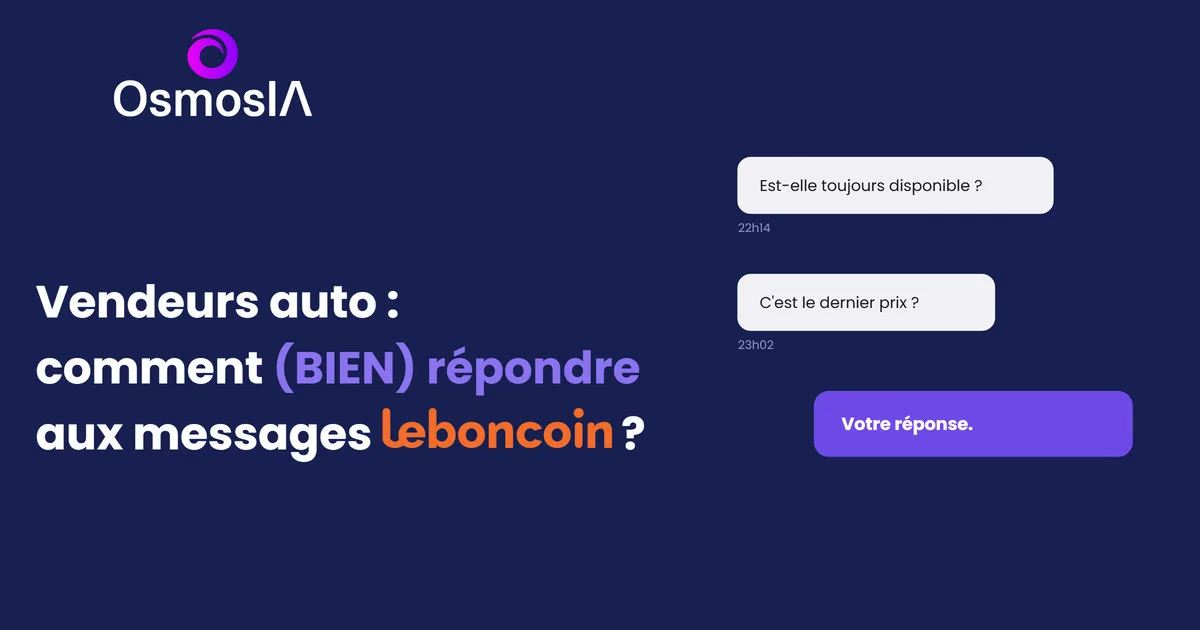
On Monday morning, before the first bonnet is even open, you open leboncoin. Fourteen messages waiting since Friday evening. An hour and a half later, everyone has an answer. And of those fourteen contacts, several have already bought elsewhere.
Not because your vehicle was presented worse, nor because your price was higher. Because another seller replied on Saturday at 6 pm.
We worked on this subject with more than 100 car sellers across France, on a base of more than 10,000 messages received. What these exchanges show is simpler, and more awkward, than you would expect: it is not that sellers answer badly, it is that they rewrite, every day, for years, the same answers to the same questions.
Messages arrive when you cannot answer
Across the 10,000 conversations analysed, the message peak starts around 11 am and only drops after 11 pm. Saturday and Sunday included. The only lull is the night.
In other words, buyers write while you are in a meeting, on a test drive, at the table or at home. Rarely while you are sitting in front of your inbox.
The cost sits in three places:
- The delay. A message received on Saturday evening and handled on Monday morning arrives after the buyer’s decision, not before. That is what the first fifteen minutes measure.
- The repetition. Writing a variant of the same sentence forty times a week is time nobody invoices.
- The inconsistency. On Monday you answer fast and short because the pile is high. On Thursday you take your time. The buyer only ever sees one thing: the reply he got.
That third point is the most expensive one in a team. Two sellers at the same dealership do not give the same answer to the same message, and nobody notices, because those conversations are never read back.
Fast is not enough
An Opel Corsa at €13,990. At 6:14 pm: “Hello, I’m interested in your listing! Is it still available?” At 6:17 pm: “Hello, yes it’s available.”
Three minutes. Hard to be faster. And yet nothing happens. The buyer has his information and no reason to write another word, and you have neither his number, nor a slot, nor the faintest idea of his plan.
Speed gets you into the conversation ahead of the competition. The quality of the reply gets you the appointment. Both are needed, and neither makes up for the other.
100 sellers, 10,000 messages: the four requests that come back
In these conversations, the same thing keeps coming back. Requests fall into four families:
- Availability: “Is it still available?”. It comes up in 65.8 % of conversations.
- Money: part-exchange, financing, negotiation. 23.1 %.
- The visit: test drive, opening hours, appointment. 21.6 %.
- Proof: service book, invoices, roadworthiness test. 12.3 %.
The total exceeds 100 %: the same buyer often asks several questions in one conversation.
Four families. Thousands of messages. And every time, a reply written from scratch.
The method was born from that observation: if the requests are predictable, the answers can be too. Not to answer mechanically, but to stop having to think about the wording, and to keep your energy for what matters: securing the appointment.
Availability: confirm without closing the door
It is the most frequent request, and the one handled worst, precisely because it looks easy.
What that message really says is not “is it available”. It is “is this worth my attention”. The buyer is waiting for a signal, not a service-desk reply.
A “yes” confirms, then closes the conversation. A good reply confirms, adds a reason to care about the vehicle, and leaves the buyer something to answer.
A precise slot beats an open invitation. “Drop by whenever you like” asks the buyer to make the effort of deciding; “tomorrow at 2 pm or Thursday at 5 pm, which suits you?” only asks him to choose.
Money: the price always comes too early
“Is that your best price?”, often the first message, before any visit, before any technical question.
Two habitual reactions, equally expensive. Give ground immediately, then negotiate from a weakened position. Or dig in, “price not negotiable”, and lose a buyer who was simply testing the ground.
The price alone invites negotiation. The price with what it includes invites an appointment: the preparation, the checks carried out, the warranty. Value cannot be defended in writing; it is defended in front of the vehicle, service book in hand. Answering a discount request therefore means acknowledging the question, setting the frame, and proposing to talk it through by voice.
Part-exchange and financing follow the same logic. A written part-exchange estimate, given without seeing the car, commits you to a figure you will have to correct later: ask for the registration, the mileage and photos, and present the estimate over the phone. A monthly payment is prepared for the specific vehicle and presented during a conversation.
The visit: the most advanced buyer
“Can I come and test drive it on Saturday morning?” Someone asking for a test drive or your opening hours has already made his choice on the listing. This is the buyer you must never leave waiting.
A test drive needs preparing: driving licence, ID, a vehicle ready to go. It is best arranged by voice. Offer two precise slots, and block the one he picks during the call.
Proof: answer fully, then invite him to check
Mileage, service book, invoices, roadworthiness test. These messages are legitimate, often precise, and this is where time disappears fastest: each reply is a small file.
Two traps. The first: answering partially, which triggers a second question, then a third, and a conversation that drags over three days without ever producing an appointment. The second: answering too much, in a wall of text nobody reads, which replaces the visit instead of preparing it.
The right measure is to answer fully what was asked, then offer to go further. Sending photos of the service book before the buyer travels takes one minute, and it is often what makes him come.
The four mistakes that cost sales
- The one-line reply. “Yes it’s available”, and nothing else. It does not set you apart from any of the other replies he receives.
- Replying the next morning. Saturday’s message handled on Monday. Evenings and weekends are where it plays out: by the next day, other sellers got there first.
- Giving the price, and nothing else. The amount alone, sometimes followed by “it’s firm”. It invites negotiation, not an appointment.
- The automatic holding message. “We have received your request.” It uses up your only advantage, being first, without moving anything forward. Answer the substance.
The method: a reply in four steps
The four families are handled with the same structure. That is what makes the method fit on one page.
- Acknowledge. The buyer knows a human read his message, not a robot. One line is enough.
- Answer. His question is answered in the first line. No detour, no condition.
- Add. A piece of information he did not ask for, which helps him decide. This is what sets you apart.
- Open. A concrete next step: two time slots, or a question he can answer in three words.
The structure invents nothing: it is what the best-converting sellers do naturally. The method only makes it explicit, so that it no longer depends on how tired you are on a Friday evening.
In practice: the same question, handled well
A Ford Transit Connect at €11,880. At 10:41 pm, the same question as before: “Is it still available?” The reply goes out at 10:52 pm, in four beats.
- Acknowledge: “Thank you for your interest in our Ford Transit Connect.”
- Answer: “It is still available.”
- Add: “You can see it by appointment or on a video call.”
- Open: “What would you most like to know about this vehicle?”
Eleven minutes, four sentences, and the buyer now has a question to answer.
Standardise without robotising
This is the objection you hear every time: “if everyone answers the same way, it shows, and it rings false”.
It would be fair if you standardised the words. What has to be standardised are the decisions: within what delay you answer, what is never handled in writing, how a message ends. The vocabulary stays the seller’s own.
In practice, in a team or a network:
- Set a shared response time, weekends included, and a clear rule for absences: a message picked up by a colleague beats a perfect message sent on Monday.
- Share the 10 ready-made replies, and ask every seller to rewrite them in his own words. A reply you have not rewritten is a reply you will not use.
- Read back the conversations once a month. It is the only way to see what buyers actually receive.
A seller trained in this method does not answer faster because he types faster. He answers faster because he no longer has to decide what to write.
Three habits, starting tomorrow morning
No software, no subscription, no budget.
- Three appointments with your inbox. One in the morning when you arrive, one before noon, one before you leave. And five minutes on Sunday early evening. That is what brings a delay of a whole day down to a few hours, without changing anything else.
- Ready-made replies within reach. In your phone’s notes and in a document on your computer. You no longer think about what to write: you paste, replace the words in brackets, and send.
- One follow-up, only one, with something new. Any message unanswered for 48 hours: a new detail about the vehicle, and a way out. It is the most profitable habit on the list, and the one nobody keeps.
Downloading the method
The 4-step method and the 10 ready-made replies are gathered in the webinar deck, as a PDF (in French). The replies are ready to copy and paste: all that is left is to replace the words in brackets.
FAQ
What you're probably wondering
Across 10,000 conversations analysed with over 100 car sellers: availability ("Is it still available?", in 65.8 % of conversations), money (part-exchange, financing, negotiation, 23.1 %), the visit (test drive, opening hours, appointment, 21.6 %) and proof (service book, invoices, roadworthiness test, 12.3 %). One conversation often contains several.
The peak starts around 11 am and only drops after 11 pm, Saturday and Sunday included. The only real lull is the night. Messages mostly arrive while the seller is in a meeting, on a test drive or at home.
No. Speed gets you into the conversation ahead of competitors; the quality of the reply gets you the appointment. "Yes, it's available", sent in three minutes, is fast and leads nowhere. Both are needed, and neither makes up for the other.
Acknowledge the message, to show a human read it. Answer the question in the first line. Add a useful piece of information the buyer did not ask for. Open a concrete next step: two time slots, or a question he can answer in three words.
No. The method was designed to work with what the seller already has: a phone and the leboncoin app. A tool becomes useful later, when the point is to answer in the evening and at weekends without being on call.
Not if they are rewritten in the seller's own words. You do not standardise the tone, you standardise the decisions: the response time, what is never handled in writing, and how a message ends.
The four families of requests appear everywhere, worded differently. The method was built from leboncoin messages, but nothing in it is specific to leboncoin.
Read next
-
 Sales Strategy
Chinese brands in France: a network doubling, buyers comparing
7.9 % of the market in July 2026, against 2.6 % in January. Networks are built in months, and buyers arrive with questions nobody had to handle before.
Pierre Osmont September 27, 2026 6 min -
 Sales Strategy
Car agency franchises: unifying lead replies across the whole network
In a car agency franchise, the reply a buyer gets is a brand asset. What a network should standardise, and what belongs to the branch.
Pierre Osmont July 24, 2026 8 min -
 Sales Strategy
Buying a used car: dealer or private seller?
France's used car market splits almost evenly between the two. What actually differs between a professional seller and a private one.
Pierre Osmont July 9, 2026 6 min

And you, what's your news?
Let's talk it through, Test Osmosia on your listings.
- A reply to every message in under 15 minutes, 7 days a weekReplies 7 days a week in under 15 minutes
- Prospects qualified and scored automatically
- Appointments booked in your calendar