Leboncoin and your CRM: when your tools don't talk, your buyers get lost

A buyer writes on a Leboncoin listing on a Tuesday at 9 pm. The message exists. It sits in the platform’s inbox, and a notification goes out to an email account. The next morning, a salesperson opens the CRM, the software where they track customers and follow-ups, and the buyer is not there: nobody has imported them yet. They may be there by noon, re-keyed by hand, without the question they asked. In the meantime, the buyer has written to two other sellers.
AAA Data counted more than 5.39 million used vehicle transactions in France in 2025, across all channels (Journal de l’Automobile, January 2026). According to Carvivo, which sells lead-handling software, Leboncoin was in summer 2023 the leading source of used car requests for the dealerships it equips, with about 14 requests per dealership per month, ahead of dealers’ own websites and then La Centrale (Journal de l’Automobile, 2023).
A message’s journey, and the four places it gets lost
The notification email. Leboncoin alerts the professional to a new message by email or through a notification in its app (terms of use, October 2026). La Centrale works the same way: the buyer calls or sends a message, and the platform’s lead-tracking tool notifies the seller by email. As long as that email is the starting point for everything else, an email that lands in spam, or goes to the inbox of a salesperson on leave, makes the buyer vanish for every tool downstream. The protective step: check that notifications are switched on for each shop, and that they go to an address someone reads every day.
The next-day import. When requests enter the CRM through a file exported and then imported once a day, the 9 pm buyer waits for the next batch. And delay costs sales. Harvard Business Review measured, across 2,241 US companies in all sectors, an average delay of 42 hours among those that responded, and 23 % that never responded (Oldroyd, McElheran, Elkington, 2011). The same article draws on an analysis of 1.25 million leads: a contact attempted within the hour was nearly seven times more likely to lead to a real conversation than one attempted an hour later.
Re-keying. Copying a request into a CRM loses whatever does not fit in the fields: the buyer’s exact question, the tone of the message, the listing they wrote about, the time they wrote. Salesforce, a CRM vendor, surveyed 5,500 salespeople in 27 countries: they report spending 70 % of their time on something other than selling, and only 35 % fully trust their company’s data (State of Sales, 2024). In the United States, an analysis published by Autotrader, which sells advertising to dealerships, found that out of 875,000 car sales, only 8 % left a usable trace in the dealership’s CRM (Autotrader, July 2025).
Evenings and weekends. We found no public French measure of the share of messages sent after closing time. A message that arrives at 9 pm is seen by no salesperson before opening, whatever the software. And even during business hours, handling has gaps. Across the dealerships it monitors, Carvivo measured in 2022 that 72 % of used car requests received by email were handled within four hours, that 5 % were handled after 24 hours, and that 30 % of used car calls reached no one (943,189 contacts, about 650 dealerships in France, Belgium and Luxembourg, barometer reported by L’argus and Journal de l’Automobile in 2023).
A used car professional’s tool families, and what they exchange
Listing platforms. Leboncoin and La Centrale publish listings and connect buyers with sellers. They accept listings sent automatically from the professional’s software: Leboncoin’s professional terms of sale provide for direct publication from the dealer’s listing management software. In the other direction, that of buyers’ messages, we found in October 2026 no application programming interface (API, the door through which two tools exchange data without human intervention) documented by either. Leboncoin also forbids robots that collect its content without prior authorisation.
Multi-listing. This software publishes the stock on several sites at once. Some tools also retrieve requests: CK Seven, which claims 700 active customers in France (vendor’s website, October 2026), states that it imports into its software “requests received by email from Leboncoin and La Centrale”. Here again, the bridge between the platform and the software is email.
The dealer management system, or DMS. It tracks stock, purchases, sales, often the workshop. According to L’argus, Nextlane, Reynolds & Reynolds and Skilliance “between them cover the dealer market” (March 2025). Planet VO², from bee2link, is installed in 2,443 dealerships (Journal de l’Automobile, January 2026). Nextlane announces an API-based connector open to third-party vendors (2024). These systems know the vehicle better than anyone. The conversation with the buyer, however, only gets in if someone puts it there.
The CRM. It tracks customers and their follow-ups. Large networks have their own: Stellantis’s Customer First CRM runs on Salesforce, according to Carvivo (2023). An independent dealer may also choose a general-purpose CRM. La Fabrique du Net’s comparison (August 2026) points out that these tools handle neither the vehicle record nor multi-listing, and sets a useful rule: a feed by plain email that someone re-keys does not count as an integration.
Lead management tools. They centralise requests from several sources, calls included, and measure who handles them and how fast. Their value depends on what they send on to the CRM or the DMS.
Each family does its job well. The losses happen at the joins, where a person copies or transfers by hand.
Connecting a CRM: the Pipedrive example
Pipedrive is a general-purpose CRM, used in many sectors. It serves as the example here because its documentation is public and precise about what a connection can do. Its API reads and writes people, deals, activities, leads and notes. A lead is always attached to a person or an organisation, and a note can be attached to a lead as well as to a deal (Pipedrive developer documentation, 2026).
In practice, four things change when the tool that receives messages is connected to the CRM.
The lead arrives without an import, at the chosen moment. Sending everything to the CRM the second it comes in would fill the salesperson’s list with requests nobody has answered yet. The right setting lets the automatic reply work first: for example, a qualified buyer goes through within 10 minutes, a buyer who wrote a real message goes through after a delay set with the team, and one who only saved the listing as a favourite is not sent, since there is nothing to reach them with. The salesperson receives a conversation already under way, rather than a pile of “is it still available?”.
The conversation lands in the notes. The salesperson who calls back reads what the buyer asked and what they have already been told. They do not ask again for a budget or a trade-in the buyer has already given.
The salesperson knows whom to call first. If each conversation carries a level of interest, the morning list sorts itself: the buyer asking for an appointment on Saturday comes before the one asking whether the car is still available.
The tool that replies goes quiet once a salesperson has taken over. Two voices answering the same buyer, one automatic and one human, end up contradicting each other. The rule is decided before connecting, and it works better when it rests on a call actually made than on a stage people change out of habit. A salesperson may move a record forward after only leaving a voicemail: the buyer has spoken to no one, and the tool would go quiet too early. It is better for it to stop once the salesperson has actually reached the buyer, for example when they set “Contact made” in the “call outcome” field the team already fills in. Converting the lead into a deal, on the other hand, counts as taking over: the tool stops too.
None of this installs in one click. Who receives the leads, and when automatic replies stop: these rules are decided with the sales team, before anything is connected. A buyer who writes about two listings must remain a single person in the CRM. And if an import or another tool already creates records, you have to choose which one does it, otherwise every buyer arrives twice.
The level of interest is best set with the labels the team already uses, hot, warm or cold for example, rather than with one more field nobody looks at. Also check that the record arrives with a way to reach the buyer, ideally a phone number: without it, it is of little use to a team that calls back.
Four questions to ask your software
Do you have an open, documented API? A file import is not one: it assumes someone exports, then imports, at a set time. Ask for the documentation page, not a brochure.
Can I regenerate the access token myself, and what happens then? The token is the key you hand to another tool. At Pipedrive, an account has only one active personal token at a time, and generating a new one cuts off every integration that used the old one (Pipedrive documentation, 2026). It is the right move after an employee leaves. It requires knowing in advance which connections depend on that key. This personal token is tied to one user and opens all of that user’s data. Only apps installed through a Pipedrive authorisation, where the user accepts the rights requested, can be limited, to read-only for example (Pipedrive developer documentation, 2026). So choose the user whose token you hand over, and never send it by email or message.
What can I read, and what can I write? A tool that lets you read records but not write a note will still force you to copy the conversation. Ask for the list, object by object: contacts, deals, notes, appointments, vehicles.
What happens when a third-party service goes down? A connection always meets an outage sooner or later. Pipedrive documents its own: an automatic alert that fails is retried three times, after 3, 30 and then 150 seconds, and is deleted after three days of failures; beyond the allowed volume of calls, the API returns a temporary refusal (Pipedrive documentation, 2026). Your provider should be able to tell you what happens to messages that arrive during the outage, and who is alerted.
How we work at Osmosia
Osmosia replies to the messages buyers send on automotive professionals’ Leboncoin and La Centrale listings, in under fifteen minutes, from 7 am to 11 pm, seven days a week. It too starts from the notification the platform sends: an email that never arrives is a message it does not see. It qualifies the request and offers an appointment.
If your dealership works with Pipedrive, we can connect Osmosia to your account. Each buyer arrives as a lead, one per vehicle, and remains a single person if they write about two listings. Their conversation sits in a single note, rewritten at every exchange, with its temperature in the title; a qualified lead is pinned, and a “Call” activity is waiting in the salesperson’s day. Osmosia stops when a salesperson sets “Contact made” on the lead, or converts it into a deal. A buyer who only saved the listing as a favourite is not sent: a favourite almost never comes with a phone number. And when a deal is won, Osmosia recognises the sale. When each lead goes into Pipedrive, and who receives it, are decided with you before launch: the full detail is on our Integrations page.
If you receive your requests through Leboncoin and La Centrale and want to see what these replies look like on your own listings, request a trial.
FAQ
What you're probably wondering
Because each was built for one job: the listing platform publishes ads and connects buyers with sellers, multi-listing software publishes the stock on several sites, the dealer management system tracks stock and sales, the CRM tracks customers. Between the platform and the rest, the documented link is usually a notification email: Leboncoin alerts the professional to a new message by email or through its app, according to its terms of use consulted in October 2026.
In October 2026, we found no public or partner API documented by Leboncoin or La Centrale for retrieving buyers' messages. The documented automated feeds are used to publish listings from the professional's software. Messages arrive in the platform's inbox and are flagged by email. One multi-listing vendor, CK Seven, states that it imports into its software the requests received by email from Leboncoin and La Centrale.
It can work for tracking prospects and follow-ups, provided you know what it does not do. La Fabrique du Net's comparison (August 2026) notes that general-purpose CRMs handle neither the vehicle record nor multi-listing. A general-purpose CRM is therefore judged mainly on what it lets you connect: Pipedrive documents an API that reads and writes people, deals, leads and notes, and sends automatic alerts when a record changes (Pipedrive developer documentation, 2026).
Four things. An open, documented API (the door through which another tool reads and writes your data without re-keying), not just a file import. An access token, the key handed to that other tool, which you can regenerate yourself while knowing what it cuts off. The list of what the tool lets you read and write, object by object. And what is planned when a third-party service goes down: what gets retried, and who is alerted.
According to Pipedrive's documentation (2026), an account has only one active personal API token at a time. As soon as a new token is generated, every integration that used the old one stops working until it is given the new one. It is a useful safeguard after an employee leaves or a leak, but it has to be planned: you need to know in advance which connections use that token. The token also gives access to all the data of the user who generated it: choose that user carefully, and never send the token by email or message.
Read next
-
 Sales Strategy
Chinese brands in France: a network doubling, buyers comparing
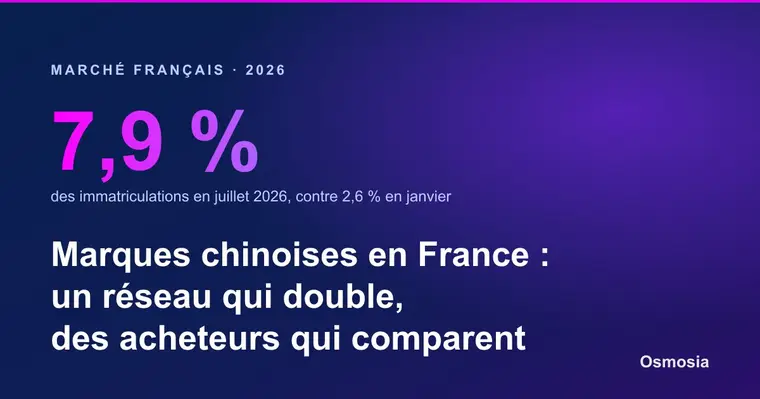
7.9 % of the market in July 2026, against 2.6 % in January. Networks are built in months, and buyers arrive with questions nobody had to handle before.
Pierre Osmont September 27, 2026 6 min -
 Sales Strategy
leboncoin messages: the method distilled from 10,000 seller conversations
Built with over 100 car sellers and more than 10,000 messages received: the four requests that always come back, and how to answer them without losing your mornings.
Thomas Forget August 31, 2026 8 min -
 Sales Strategy
Car agency franchises: unifying lead replies across the whole network
In a car agency franchise, the reply a buyer gets is a brand asset. What a network should standardise, and what belongs to the branch.
Pierre Osmont July 24, 2026 8 min

And you, what's your news?
Let's talk it through, Test Osmosia on your listings.
- A reply to every message in under 15 minutes, 7 days a weekReplies 7 days a week in under 15 minutes
- Prospects qualified and scored automatically
- Appointments booked in your calendar